
Native Seed Laboratory Technician
Resource Development Restoration
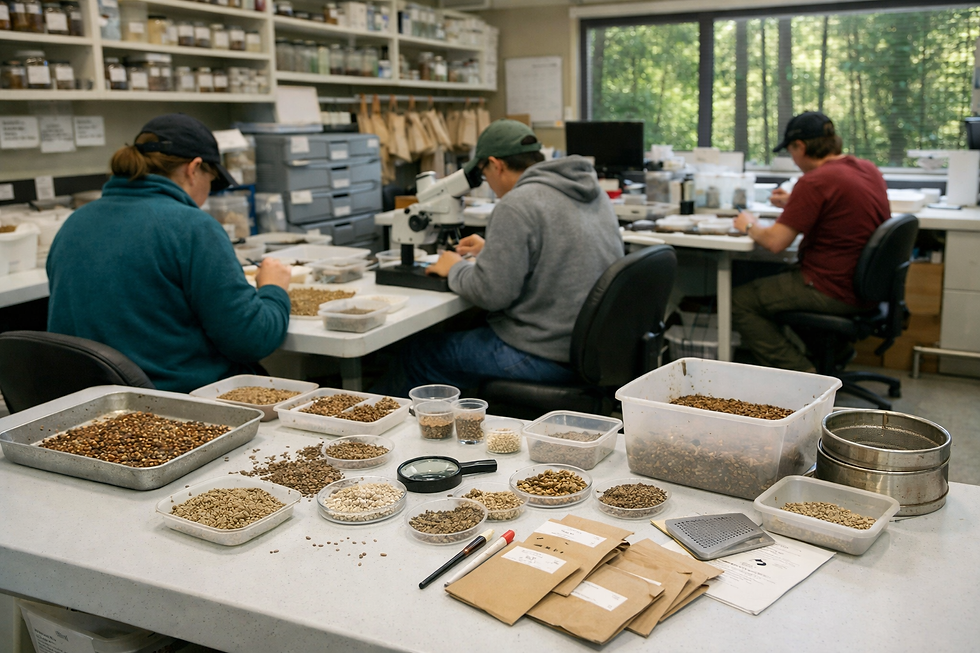
A Native Seed Laboratory Technician processes and prepares seed collections for nursery production or long-term storage. The work is precise, methodical, and takes place at the bench — cleaning seed lots, running viability tests, maintaining records, and managing storage. It's not field work, but it's directly connected to what happens in the field. The quality of your processing affects what the nursery can grow and, ultimately, what gets planted.

Experienced
Experience Level
Year-round
Seasonality
Low
Physical Demands
Lab technician work in seed processing suits people who appreciate precision and find satisfaction in systematic, detail-oriented tasks. You're doing work that requires genuine botanical knowledge and careful technique — not just following a protocol mechanically, but understanding why the protocol matters. The connection to restoration and seed conservation gives the work a larger purpose, even when you're spending hours at a cleaning bench.
A DAY IN THE LIFE
A typical lab day is structured around whatever is in the queue — incoming collections to process, test runs to check, inventory to update. You might spend several hours cleaning a large seed lot, then shift to running germination tests, then update the database. The work is quiet and focused. The satisfaction is in doing it consistently well.
WORKING CONDITIONS
Indoor lab environment: controlled, clean, and quiet. The work is sedentary with fine motor demands. It suits people who can maintain focus and consistency across repetitive precision tasks. Year-round work with workflow tied to collection cycles.
CYCLICAL NATURE OF ROLE
Year-round with workflow intensity tied to collection seasons. Fall tends to bring higher processing volumes following summer and fall collection periods.
REQUIRED EDUCATION & TRAINING
REQUIRED SOFT SKILLS
Precision and consistency in repetitive technical tasks
Meticulous data recording and documentation
Patience and sustained focus across long bench sessions
Methodical approach to protocol compliance Communication with program coordinators and nursery staff
REQUIRED HARD SKILLS
Post-secondary training in plant science, biology, horticulture, or a related field is an asset
Experience with lab work or seed handling is helpful
On-the-job training in specific protocols is typically provided
WHMIS certification is required
Attention to detail and data management skills are required
Familiarity with native BC plant species is an asset
ON THE JOB LEARNING
Seed processing and cleaning technique
Germination testing and viability analysis
Seed lot documentation and inventory management
Native plant seed identification and morphology
Cold storage and seed bank protocols
FUTURE CAREER OPPORTUNITIES
Seed lab experience is a foundation for roles in seed bank management, native plant nursery production coordination, botanical research, and restoration program support. Some technicians develop into seed program coordination, procurement planning, or conservation seed banking careers. Skills transfer into quality assurance, research support, and ecological monitoring roles.